
Resource Library:
Training for Schools

Federal Emergency Management Agency
IS-1152: Blue Campaign - First Responder Training
This training for first responder personnel includes three lessons and a final exam. The lessons will help you understand what human trafficking is, who can become a victim, and how you can play a role in identifying and responding to suspected victims.
As a first responder, you are often first on the scene in an emergency. This gives you the unique opportunity to notice signs of human trafficking.
At the end of this course, you will be able to:
-
Identify what human trafficking is.
-
Identify who can potentially become a victim.
-
Identify how first responders can respond to suspected victims of human trafficking.
The entire program should take 45 minutes to 1 hour to complete.
Course Overview IS-1152
IS-1151: Blue Campaign - Disaster Responder Training
In this 6-minute video for disaster response personnel you will learn how to recognize and report suspected human trafficking.
As someone trained in disaster response, you are in a unique position to spot potential instances of human trafficking. Human traffickers have their guard down during these times and suspicious activity may become more apparent.
At the end of this course, you will be able to:
-
Identify what human trafficking is.
-
Identify the indicators of human trafficking.
-
Identify how disaster response personnel can respond to suspected victims of human trafficking.
Course Overview IS-1151

Training 9-1-1 Heros
Swatting
What seems to some to be a silly prank, swatting puts responders, unsuspecting residents, and bystanders in harm's way. This course will give you a complete understanding of this continuing problem.
Swatting Training

360 Training
Safe in School: Active Shooter Awareness for Kids
Unfortunately, school shootings have become a tragically common reality in this country. Preparing children for the possibility can help keep them safe if the worst should occur.
This free online course provides age-appropriate information for kids ages 6 to 12 explaining what a school shooting event is and how to prepare for it.
This online, interactive program was developed in consultation with Lindsay Loewe, LPC, NCC, a trauma-informed psychotherapist with over 12 years of experience working with children and families. It's designed to be taken under the close supervision of an adult and to keep kids feeling as safe and comfortable as possible while addressing a serious and scary subject.
This course includes an animated character that walks children through the content and activities. The material is self-paced, but we've built in regular breaks that give the supervising adult time to check in with the child and have conversations.
A brief assessment at the end of the course helps ensure that the child understands the most important safety training information.
Safe in School: Active Shooter Awareness for Kids
Active Shooter Awareness Training
Active shooter events are both unpredictable and tragically common. Active shooting incidents nearly doubled from 2017 to 2020 and increased more than 50% from 2020 to 2021. Businesses, churches, schools, event venues – no location is safe from the random violence of an active shooter.
Being prepared can be the difference between life and death.
This free 30-minute course will give you the tools you need to survive an active shooter event. We'll discuss how to recognize the warning signs of a potential active shooter, as well as how to react, how to cooperate with first responders, and the statistical outcomes of an active shooter event.
This course is mobile-friendly so you can take it on any device. It was developed in consultation with Michael S. D'Angelo, a board-certified security consultant and former Captain of the City of South Miami Police Department, using resources from the FBI and analysis of real active shooter events in a variety of different settings.
Active Shooter Awareness Training

Ohio School Safety Center-Knowledge District
Beginners Guide to 764 and Nihilistic Violent Extremist Groups
https://ossc.reach360.com/learn/course/5e999c75-61a7-49ba-b932-89b57738de10
School Violence Prevention Strategies
https://ossc.reach360.com/learn/course/31b7df9c-bd94-4e7c-8562-61e324d8ad68

Federal Emergency Management Agency
The following FEMA courses are offered through the Federal Emergency Management Agency Independent Study Program and are available free of charge in a self-paced online format. Topics include Multi-Hazard Emergency Response Planning for Schools and foundational Incident Command System (ICS) training.
How to Obtain a FEMA Student Identification (SID) Number
-
Visit the FEMA SID registration page:
FEMA SID Registration Page -
Select “Register for a FEMA SID” and complete the required information, including your name, email address, and security questions.
-
After registration, you will receive a confirmation email containing your unique FEMA SID number.
-
Retain your SID number in a secure location, as it is required to access and complete all FEMA Independent Study examinations.
How to Complete FEMA Independent Study Courses
-
Register for a FEMA SID
Obtain a FEMA Student Identification Number (SID) if you do not already have one. -
Browse Available Courses
View the FEMA Emergency Management Institute (EMI) Independent Study course catalog:
FEMA Independent Study Program -
Review Course Materials
Select a course title to access the online curriculum and study materials. -
Complete the Final Examination
Use the “Take Final Exam Online” link located on the course page. Your FEMA SID will be required to log in. -
Receive Your Certificate
Participants who achieve a passing score of 75% or higher will receive an email within one business day containing a link to their electronic certificate of completion.
Recommended FEMA Courses for School Personnel
The following five courses are recommended for all school personnel by the The "I Love U Guys" Foundation:
IS-100.c: Introduction to the Incident Command System (ICS 100) Course
Course Overview
ICS 100, Introduction to the Incident Command System, introduces the Incident Command System (ICS) and provides the foundation for higher level ICS training. This course describes the history, features and principles, and organizational structure of the Incident Command System. It also explains the relationship between ICS and the National Incident Management System (NIMS). The Emergency Management Institute developed its ICS courses collaboratively with:
-
National Wildfire Coordinating Group (NWCG)
-
U.S. Department of Agriculture
-
United States Fire Administration’s National Fire Programs Branch
IS-200.c: Basic Incident Command System for Initial Response (ICS 200) Course
Course Overview
IS200, Basic Incident Command System for Initial Response, reviews the Incident Command System (ICS), provides the context for ICS within initial response, and supports higher level ICS training. This course provides training on, and resources for, personnel who are likely to assume a supervisory position within ICS.
The Emergency Management Institute developed its ICS courses collaboratively with:
-
National Wildfire Coordinating Group (NWCG)
-
U.S. Department of Agriculture
-
United State Fire Administration’s National Fire Programs Branch
Note: IS-200.c is an updated version of the IS-200 course. If you have successfully completed IS-200.b or IS-200.a, you may want to review the new version of the course. For credentialing purposes, the courses are equivalent.
NIMS Compliance
This course is NIMS compliant and meets the NIMS Baseline Training requirements for IS-200.
IS-362.a: Multi-Hazard Emergency Response Planning for Schools Course
Course Overview
This course covers basic information about developing, implementing, and maintaining a school emergency operations plan (EOP). The goal of this course is to provide students with an understanding of the importance of schools having an EOP and basic information on how an EOP is developed, exercised, and maintained. The topics addressed in this course include:
-
Understanding incident management.
-
Forming the planning team.
-
Understanding the situation.
-
Developing a school emergency operations plan.
-
Incorporating the Incident Command System principles and roles in the school emergency operations plan.
-
Training, exercising, and maintaining the school emergency operations plan.
-
IS-700.b: An Introduction to the National Incident Management System (NIMS) Course
Course Overview
This course provides an overview of the National Incident Management System (NIMS). The National Incident Management System defines the comprehensive approach guiding the whole community - all levels of government, nongovernmental organizations (NGO), and the private sector - to work together seamlessly to prevent, protect against, mitigate, respond to, and recover from the effects of incidents. The course provides learners with a basic understanding of NIMS concepts, principles, and components.
IS-800.d: National Response Framework, An Introduction Course
Course Overview
The goal of the IS-0800.d, National Response Framework, An Introduction, is to provide guidance for the whole community. Within this broad audience, the National Response Framework focuses especially on those who are involved in delivering and applying the response core capabilities, including:
-
Private sector partners
-
Non-governmental organizations (NGOs)
-
Government officials
-
Community leaders
-
Emergency management practitioners
-
First responders
-

Texas A&M Engineering Extension Services
Several courses covering Active Attack leadership, Measures for After-School Activities and Active Attack Emergency Communications.
https://teex.org/resources/student-portal/
LET221 - Active Attack Event Response Leadership Course
In the past two decades, horrific mass shootings have been thrust into public consciousness. Mitigating the effects of these events is the responsibility of those who serve in our communities’ public safety organizations. The public expects an effective and swift response to these threats.
The goal of this online course is to provide leaders in first response and emergency management agencies with strategic leadership and integrated response strategies that will prepare them to not only “stop the killing” but to also “stop the dying” in active attack events. Participants will also be able to recognize the need to prepare their communities for an active shooter attack and use this as an opportunity for positive outreach and community interactions.
https://teex.org/class/LET221/
AWR375 - A Strategic Approach to Safety & Security Measures for After-School Activities Course
The goal of this online course is to enhance the safety and security awareness of individuals responsible for organizing, supervising, and supporting after school activities and interscholastic athletics. This course focuses on developing prevention/mitigation, preparedness, and response strategies at after-school activities and interscholastic athletic events. Through interactive online learning modules, participants will develop an increased understanding of risk assessment and management, communications, mitigation and planning, professional development, and best practices. The expectation is for participants to gain an awareness-level knowledge of after-school activity and interscholastic athletic event risk management techniques.
https://teex.org/class/AWR375/
LET223 Active Attack Emergency Communications Course
Over the past twenty years, active attack response training has focused on training law enforcement to arrive quickly on scene and engage violent suspects. In recent years that focus has shifted to the fire and EMS community with the introduction of different casualty evacuation models. This online course expands the focus to include another vital part of the community response team: telecommunicators.
Each link in this survival chain is important. Our response system must move through the chain as quickly as possible, even with the myriad of variables that can make it difficult. What saves lives in these events is rapid stabilization and transport to definitive care. Telecommunicators, are uniquely positioned to help speed the team towards this goal.
https://teex.org/class/LET223/

Alison LMS
Violence in Schools: Understanding Causes and Creating Solutions Course
Discover practical strategies used for creating safer learning environments in this free online course.
This course provides a foundation for understanding the causes and consequences of violence in schools. You will explore how different factors shape children’s behavior, as well as the roles teachers, parents, and peers play in preventing and addressing violence. The course offers practical strategies for prevention and intervention, making it valuable for educators, parents, and professionals working with children.
https://alison.com/course/violence-in-schools-understanding-causes-and-creating-solutions


Colorado School Safety Resource Center
School Security Personnel: Observation Skills and Incident Reporting Course
**School Security Personnel: Observation Skills & Incident Reporting
**created by the Colorado School Safety Resource Center, Department of Public Safety
This module is designed as an overview of basic observation skills, techniques for building these skills and some of the issues that can hinder observation skills.
After completing this module, you will be familiar with:
-
Observation skills, and factors that affect perception and memory
-
The duties en route to and at a scene
-
Considerations of the school security responder in regard to crime scenes, first aid, explosives, and victims or witnesses
-
Basic report writing skills
Plan for about 1 hour to complete the course and review the resources.
https://oss.colorado.gov/trainings/online-training
School Security Personnel: Professional Conduct and Ethics Course
**School Security Personnel: Professional Conduct & Ethics
**created by the Colorado School Safety Resource Center, Department of Public Safety
This module is designed as an overview of the school security profession.
After completing this module, you will be familiar with:
-
The history of school security
-
The authority of a School Security Professional both during the school day and at after school events
-
The School Security Professional’s role in the school structure and organization as they relate to campus personnel, stakeholders and students
-
The School Security Professional’s responsibilities in the educational environment
-
The school security code of ethics
Plan for about 1 hour to complete the course and review the resources.
https://oss.colorado.gov/trainings/online-training

COPS Training Portal
An Introduction to SRO Programs
An Introduction to SRO Programs, an eLearning course, directly supports the mission of the National Association of School Resource Officers to provide the “highest quality of training to school-based law enforcement officers.” This course provides an overview of school-based law enforcement programs and illuminates the critical need for further SRO training.
https://learn.copstrainingportal.org/course/view.php?id=238

Pennsylvania Commission on Crime and Delinquency
NOTE: The PCCD is not authorized to provide or acknowledge any other type of credit or completion certification for other state professional development requirements, beyond the Act 55 completion certificate that is displayed at the end of each module.
Sign-In Instructions for PCCD Learning Modules
IMPORTANT: Pennsylvania residents should simply complete the requested information. Out of State requests should follow the below instructions.
1. Once you click on your course selection, you will need to log in.
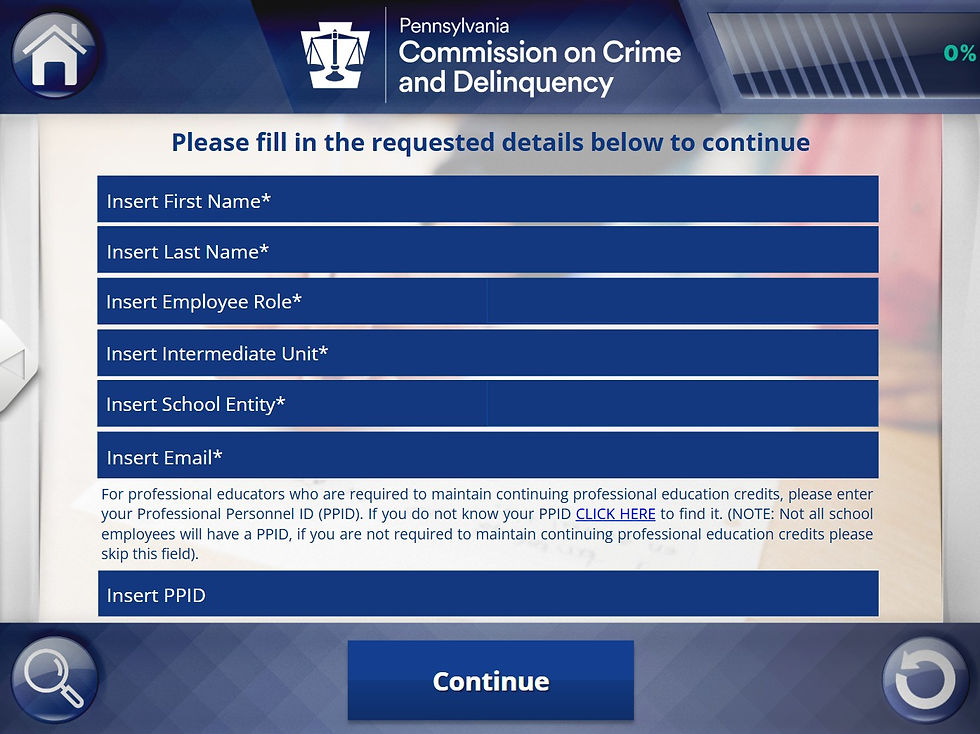
2. Enter your First Name, Last Name and Employee Role
When you click on "Intermediate Unit", please select "Midwestern Intermediate Unit".
This is needed for the PCCD analytical data.
